

AI doesn't run itself. Someone has to lead and decide which tools the organization uses, how they're deployed, who gets trained, and what guardrails are in place. Without that ownership, even the best intentions around AI tend to stall or go sideways.
So who's actually in charge? That's one of the questions the 2026 State of AI for Business report set out to answer. The report surveyed more than 2,100 professionals across industries and company sizes, and the results reveal just how varied — and in some cases, unsettled — AI ownership really is.
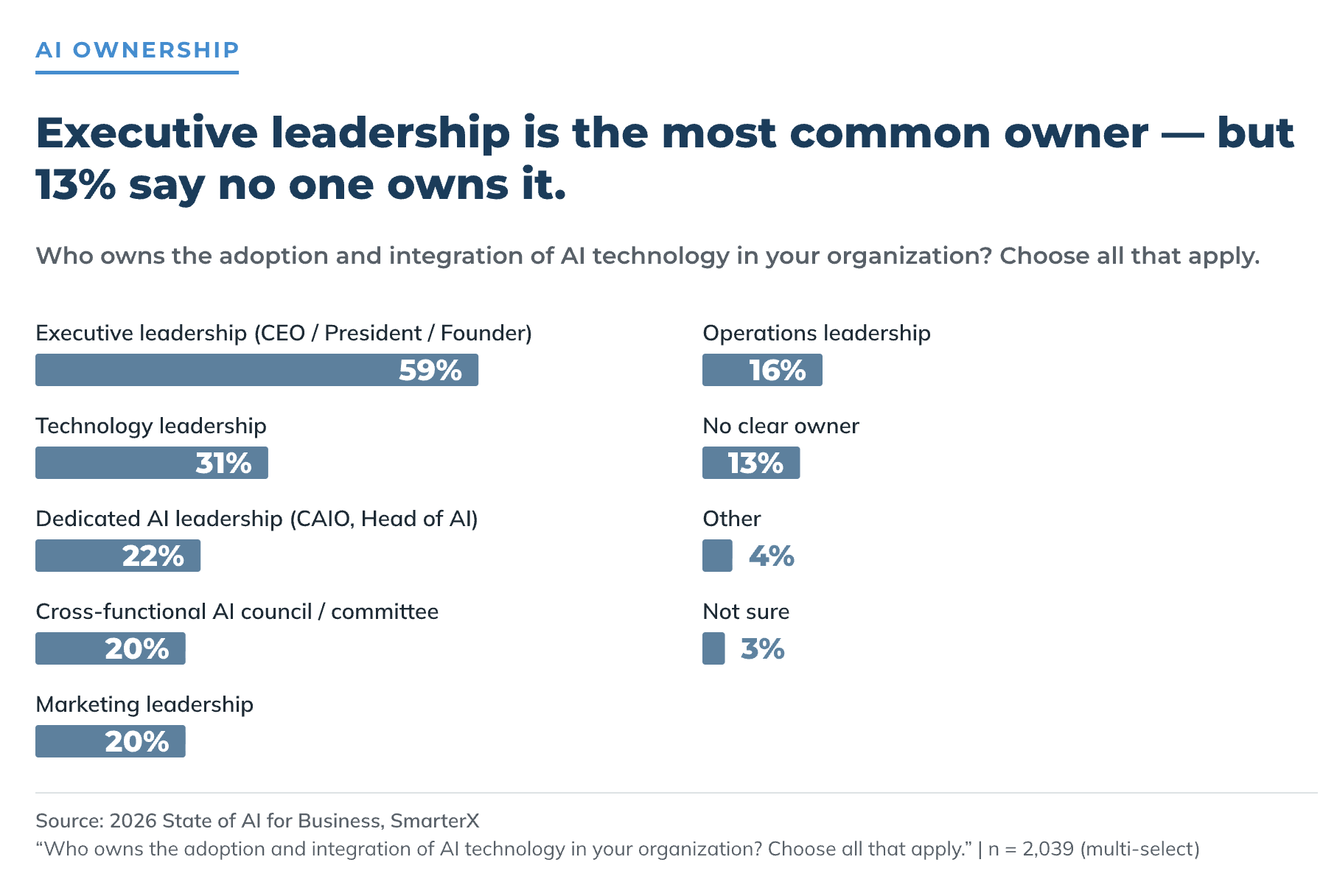
When asked who owns the adoption and integration of AI at their organization, here's what respondents said: (Note; They could select all that apply.)
-
Executive leadership — 59%
-
Technology leadership — 31%
-
Dedicated AI leadership — 22%
-
Cross-functional AI council — 20%
-
Marketing leadership — 20%
-
Operations leadership — 16%
-
No clear owner — 13%
-
Not sure — 3%
(Percentages exceed 100% because respondents could select all that apply.)
Why AI Leadership Matters
Executive leadership topping the list at 59% makes sense. AI is a strategic priority, and leaders are claiming it. But the numbers also show that ownership is often spread across multiple functions, which can work well with the right coordination in place.
The numbers that deserve the most attention, though, are the ones near the bottom: 13% say no one owns AI at their organization, and another 3% aren't sure. That's roughly one in six people working somewhere that AI has no clear home.
Set that against another of the survey’s findings that shows 74% say AI is critically or very important, and the mismatch is stark: most organizations say AI matters enormously, but a meaningful chunk have assigned no one to lead it. That's not a small gap.
"No clear owner" doesn't mean no AI activity. It means AI is happening without direction. Tools get adopted informally. Decisions get made inconsistently. And the organization's AI future gets shaped by whoever happens to be most enthusiastic that week rather than any deliberate strategy.
There's also a quieter risk in the most common answer. When executive leadership is the sole owner of AI, progress is tied to one very busy person. The moment a competing priority lands — a major deal, a product crisis, a board meeting — AI momentum can stall.
The organizations that tend to move fastest aren't always the ones with the most senior sponsor of AI. They're the ones with a clear owner, a defined structure, and people empowered to actually execute.
If your organization is still figuring out who that should be, you're not alone. But knowing the gap exists is the first step to closing it.
This is just one data point from a report full of them. You can read and download the complete 2026 State of AI for Business Report for more insights on organizational readiness, training gaps, governance, and more.
