

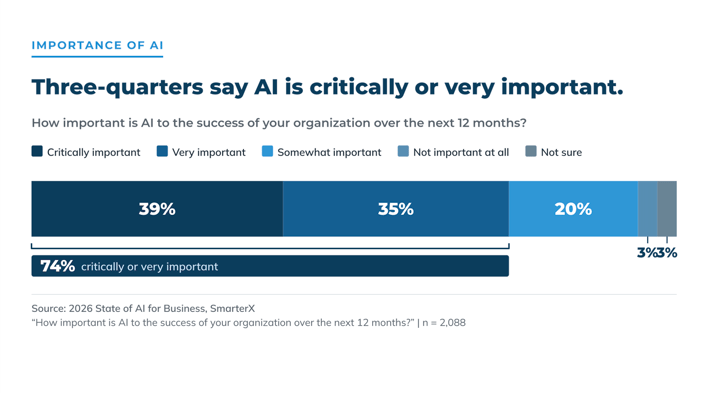
Nearly three out of four professionals (74%) say AI is "critically important" or "very important" to their organization's success in the next 12 months. Just 3% say it's not important at all.
That's one of the standout findings from the 2026 State of AI for Business Report, a survey of more than 2,100 professionals on how they understand, adopt, and organize around AI.
The survey asked respondents a simple question: How important is AI to the success of your organization over the next 12 months? The responses break down like this:
-
Critically important — 39%
-
Very important — 35%
-
Somewhat important — 20%
-
Not important at all — 3%
-
Not sure — 3%
On the surface, the story appears to be a consensus. AI matters. Almost nobody disagrees. But the real insight is hiding underneath that top-line number.
The Urgency Gap Between Leaders & Teams
When you break the data down by role, a significant gap emerges.
Among CEOs, founders, and presidents, 89% say AI is critically or very important and 57% choose "critically important" outright. Among specialists and entry-level professionals, the overall agreement is still there, but the intensity drops sharply: only 23% say "critically important."
That's a meaningful difference. Leaders aren't just bought in on AI; they feel a sense of urgency about it. But the people who are closest to day-to-day work don't share that same intensity.
This matters because urgency without alignment doesn't produce results. When a CEO is all-in on AI but the team is lukewarm, purchasing another tool won’t close the gap. Leaders need to help their teams understand why this matters to their work, and equip them with the skills to act on it.
As the report puts it: when leaders feel far more urgency than the people doing the work — and those organizations aren't investing in training or strategy — the result is a directive without a path.
What This Means for Organizations
The data suggests that the biggest risk for many organizations isn't resistance to AI. It's assuming that leadership’s urgency translates to organizational readiness. The report found that the top barriers to AI adoption aren't technical, they're human. A lack of education and training (38%), lack of awareness or understanding (35%), and lack of time (30%) top the list.
If you're a leader who feels strongly that AI is critical to your success, this data is a reminder to tune in. Does your team share that conviction? Do they have the training, time, and support to act on it? If not, the urgency you feel may not be translating into the progress you expect.
Check Out the Full Report
This is just one data point from a report full of them. You can read and download the full 2026 State of AI for Business Report for more insights on organizational readiness, training gaps, governance, and more.
️
